The last two months on the croft have seen many good days for working outdoors with the cold sunny weather. We’ve also discovered the joys of regular swimming as a way of dealing with our aching backs and getting a work-out without adding to the wear and tear on our bodies the croft is giving us. I sometimes get upset that people see me as a tree person, (which I have no background in other than being married to one!) and not a filmmaker and screenwriter but this month’s piece is all about trees and forestry so I am playing to this stereotype.
This month we cut down two ash trees that were dying and too close to the road for safety. These were two of the many on our croft that will need to be felled or come down because of ash dieback and many more ash trees will need to be felled throughout Morvern. The same week we received a letter telling us Phytophthora ramorum has been found in the neighbouring plantation larch trees; it has also been found in plantation larch throughout Morvern. These two separate tree pandemics are the result of imported tree saplings brought to the UK. They are a man-made by-product of a globalised market economy and tree growing industry.
There seems to have been lots of talk in Morvern recently about conifer plantations. These plantations surround all of us who live here, and this becomes more apparent in the winter months when the other trees have lost their leaves. Many people enjoy walking in the plantation forestry and wish that the paths were maintained better. Some people have been saying that, as an industry using local resources, Forestry and Land Scotland should be giving more back to the local community. There is also sadness about the habitats, and nice places to walk that will be destroyed when the trees are inevitably clear-felled. This is what these forests were planted for however, and so it is the only way to manage them. They are so dense that any felling (such as for the diseased larch) or windfall makes them unstable and the whole lot falls down.
A village elder who has spent a lot of time working on estates tried to convince me that conifer plantations are the best route to creating broadleaf woodland and it is true that once woodland of any type is established, there are legal restrictions preventing it being turned back into open land. However, the conifers we have here in Morvern are problematic for native woodland. They spread from the areas they’ve been planted in and become invasive. As non-native trees, the pests and pathogens that would usually limit their growth aren’t present and so native trees struggle to compete – that is until one pathogen appears and wipes them all out.
Looking at things from our croft we do see wildlife coming in and out of the conifer plantations, deer, foxes and birds traverse these woods, but the forest floor is dead. No flowers grow, just moss and, often, not even that. The comparison is made stark when you see a plantation forest growing next to a native woodland rich with thousands of species.
The same globalised market economy that spreads tree diseases around the world requires us to grow vast amounts of timber to make pallets, paper and cardboard boxes to wrap and transport other products for shipping. This timber comes from plantations of larch, Sitka spruce and lodgepole pine. Plantations which in turn are the perfect breeding ground for Phytophthora ramorum. The continual cutting down of trees and digging up of land to plant more trees for timber releases carbon, and some studies suggest plantation forestry may not even be carbon neutral. Yet these plantations are still being seen, and sold, as a positive response to climate change.
As a society we need timber products, but growing trees for these, in this way, will not help prevent global warming and is terrible for species diversity. Those who present this as the answer to climate change or biodiversity loss are at best misguided, and at worst, pulling the wool over our eyes.
It is sometimes hard to see or explain why biodiversity is so important. Having diverse species creates complex systems that we still don’t fully understand, that in turn support the deer, squirrels, birds and other mammals we love seeing. These diverse species also form our own habitat, supporting our own food systems. If we keep replacing these habitats with monocultures the result is inevitably more disease and large-scale collapse like that of the imported larch and our own poor ash trees.
In Morvern and Ardnamurchan we are blessed with fragments of native woodlands that are some of the most rare, precious and important in Britain. Unique refuges to hundreds of species that have survived in few other places.
There are other systems of forestry that combine production with other objectives, like Continuous Cover, and we need to find ways to incorporate these systems into timber forestry whilst, as the local resident community, recognising we are the current custodians of all that is precious here and it is up to us to act to protect what we have.
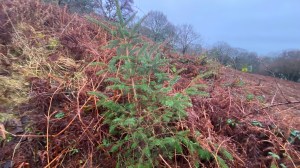
A seeded sitka on the edge of native oak woods on the croft blown in from a plantation half a kilometre away.
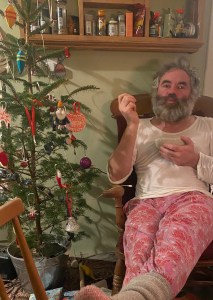
Pulled up and put to use as a Christmas tree!
 Rhemore Wildcroft
Leave a comment