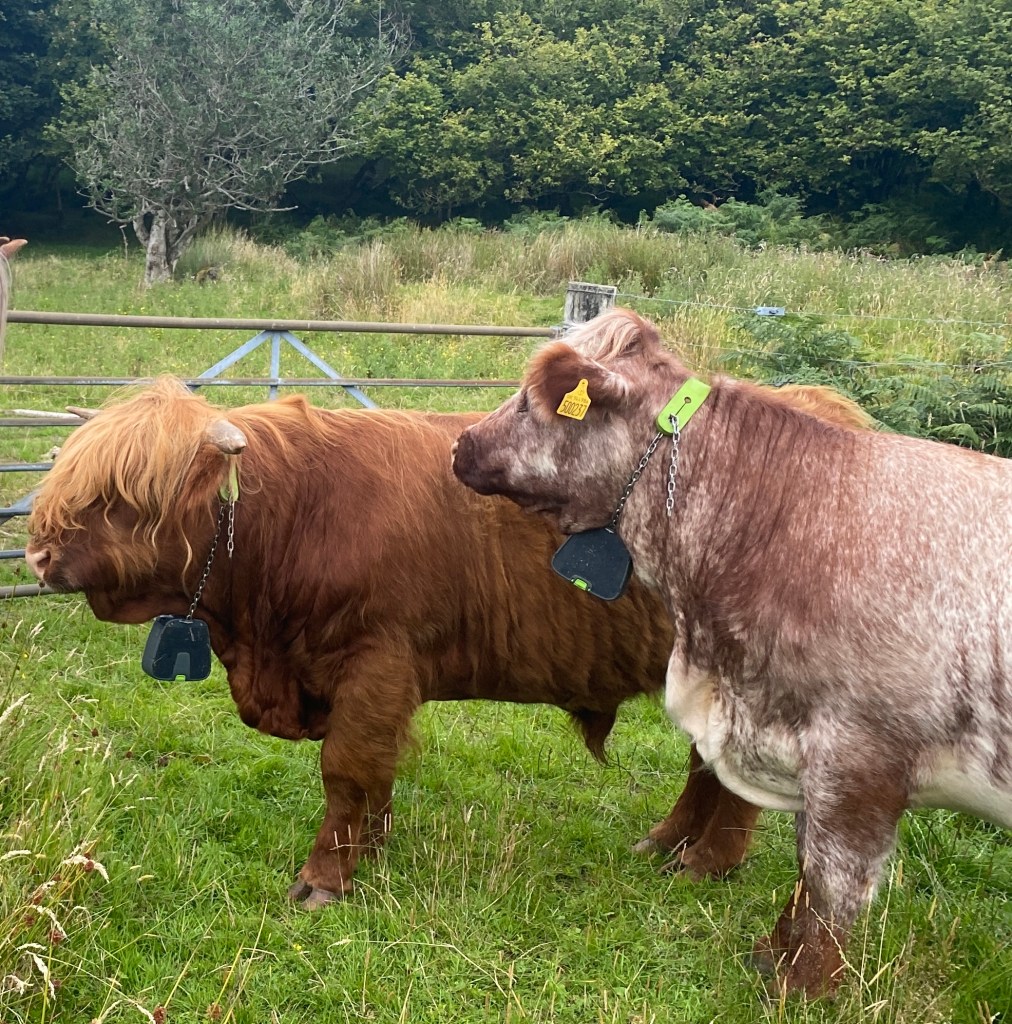
People are always interested in our cow collars. We’ve had them for three years and they’ve proven really useful. They’re expensive, but cheaper than replacing the old and broken fencing on most of our croft.
I heard about them at an online seminar on conservation grazing before we got the cows. I was intrigued, but, like many people, a little concerned about welfare,
The collars use GPS tracking to create a virtual boundary you set using an app on your phone. The cows wear collars that emit a warning tone when they approach a “virtual fence”. The tone rises in pitch as the cow comes closer to the boundary and if necessary the collar gives the cow a small electric shock. The Norwegian designers describe it as being like an electric fencing except with an audible cue instead of a visual one.
When we first got our heifers we quickly discovered how good cows are at jumping fences. It’s quite a sight when you don’t expect it to see it. They can also run pretty fast and will run straight through an old fence if they want to. Once a cow has found a way out, if they are motivated enough they will escape again and again often taking the whole herd with them.
With five heifers coming into season, falling down fences, and a nearby bull on the neighbouring estate, our first few months of livestock keeping consisted mainly of trying to find escaped cows and getting them back home. We learnt quite early on that an electric fence is sometimes the only thing that keeps cows in, but there is only so much electric fencing you can put up on a large croft.
The final push was when the crofting grant scheme starting covering collars. Only a hundred farms in Britian were using them at this point so it was great they were, in this instance, so forward thinking.
The cows needed a bit of training on the collars, as did we, but we all quickly learnt the limitations and quirks of the system. GPS is not that precise, so the boundaries of virtual fences are quite fuzzy. It helps massively if the cows can get to know where the fences are but this means you can’t change the fence line too often without getting a lot more shocks; unlike a normal fence you can’t move the cows to the next patch on the other side of a boundary, as they get confused as to which way to turn; and if a boundary is too close to a slope and they run the wrong way they pick up momentum and shocks as they go. It took us a couple of years to get enough collars for all the cows and this was a mistake as the collars work much better if every cow has one on. The collars also have a feature where they alert you when a cow hasn’t moved for a few hours, which in principle is a great, until you are woken at four in the morning and go down to a far end of the croft fearing the worst, only to find some of your cows don’t move when they are in fast asleep, or a collar has simply been pulled off and is lying on the ground.
But, being able to see where the cows are (and where they’ve been) is incredibly useful and we can pick up patterns of behaviour. We can exclude them from particular areas of the croft depending on levels of grazing or regeneration and change these areas year by year. We can put the cows down on the shore during the summer, where it is impossible to fence, and take them into areas of the croft they wouldn’t usually go. Depending on the time of year, (or the cow), they can go for weeks or months without getting any shocks and they don’t seem particularly bothered by wearing the collars.
I can imagine virtual fencing is not for everyone, and might be hard to get used to if you’ve kept cows for a long time. There is also very little, other than an incredibly well strained stock fence, that will keep two bulls apart, but the no fence collars have made all the difference for us and the woodland management on our croft.
If you are in within 20km of our croft you can track our cows at https://grazingmap.nofence.no


Leave a Reply