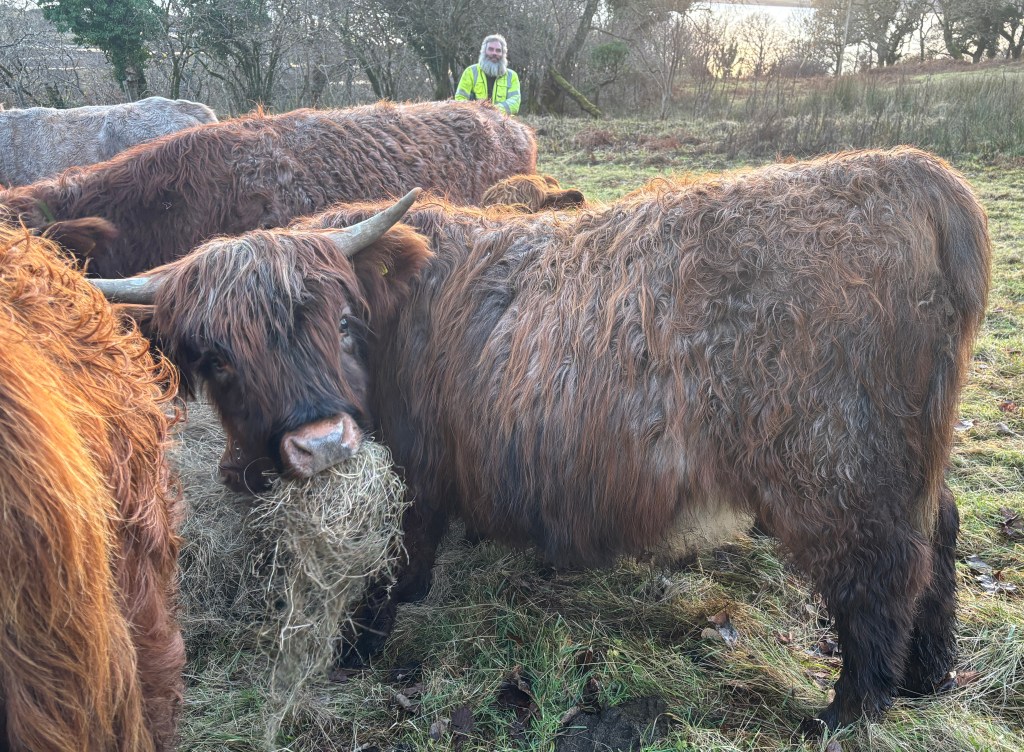
As January and February progress, we are warily eyeing the wood store and the hay barn. Last year was a good year, and with the new bailer and tedder, and the strong grass growth, we managed to bring in more hay than ever before. There still comes a point, when the cows like to make it clear each day that they would prefer to be fed a bit more.
It’s meant to be good for cows’ metabolism to lose shape over winter and there is a scoring system we use to assess their condition – but it’s quite difficult with our hairy Highlanders. Our yardstick is Gooseberry, our most food-orientated cow. She doesn’t ever lose shape and would probably be classified as overweight in the summer despite just eating grass. So, if Gooseberry loses weight, we know the herd needs more.
Winter has also exposed some of the immediate impacts of our new deer fence. This deer fence, and the similar ones our neighbours have put up, were all funded by Scottish Forestry to protect the rainforest.
It’s going to be a long time before we see the main impact i.e. protecting new saplings from browsing. In the short term the deer have been channelled into one corner of the croft, which is now heavy with tracks.
This, along with the fantastic talks we have had over winter from Jennie Robertson at the Morvern Heritage Society, has got me thinking a lot about deer management. It was fascinating to learn that archaeology suggests there was once virtually no deer on Morvern, as people grew trees and other crops with no protection.
And seeing the work it has taken to build our fences and our neighbours’ fences – and the cost of this to the taxpayer – I can’t help thinking there must be a better way.
A large proportion of Morvern is forestry and the two largest estates on Morvern seem to be shifting away from hunting for sport as their main income. This means the government is effectively subsidising a small number of landowners whose income relies on shooting for sport by putting up miles and miles of fences, when deer numbers could be managed across the whole peninsula. Surely this would be better for the deer than restricting the same number to an ever-smaller area and food source?
The heritage societies talks have shown that for centuries people managed the land in a way that was sustainable because it was in their interest to do. When land was apportioned and sold off in large chunks, its management seemed to become more about fashion and whim (as well as making money). In Victorian times, people wanted to buy into a country gentleman’s lifestyle, (and plenty still do), and so we now have an explosion of deer just so that people can shoot them.
I sometimes worry whether “rewilding” on large estates is driven as much by what’s currently fashionable, rather than what is best for the land or the people living on it.
There certainly seems to be a danger of it becoming a one size fits all model – rather than the more difficult task of understanding and responding to each individual piece of land and the needs of those who live off it. Would small scale management by people living from the land ensure it is not degraded as a common resource? Or is it in our nature to extract the maximum we can?
Which returns me to the hay, the cows, the trees and the firewood in the woodshed – and our desire to get through another winter without depleting the amazing natural resources on our croft.


Leave a Reply