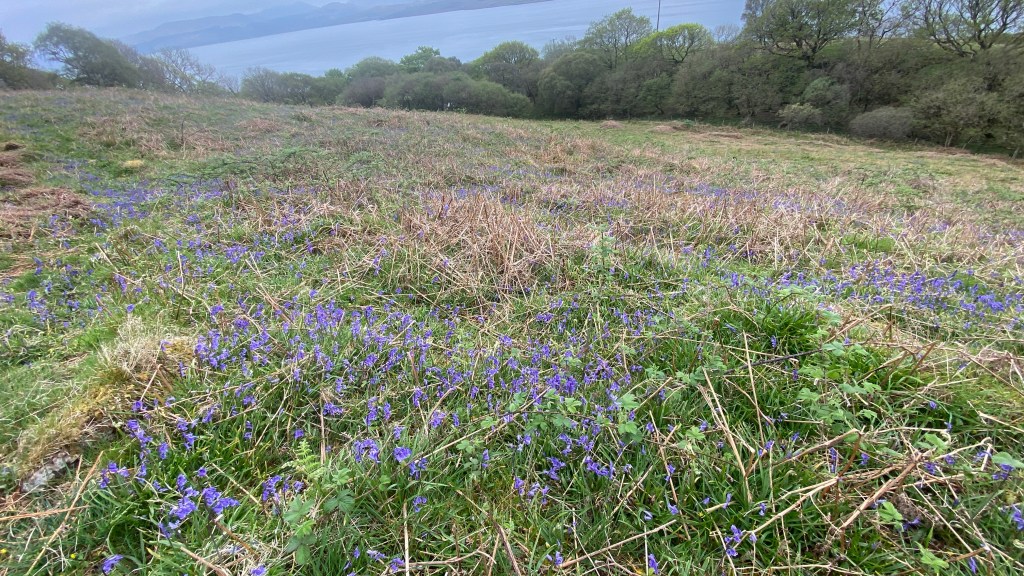
The bluebells are out and this year’s calves are due any day. Despite a long cold winter our cows seem to have weathered better than in previous years and are still in relatively good condition. Our hay baling and turning equipment has improved the quality and quantity of the hay we are producing, and the deer fence has brought down the number of lice, if not the ticks – although we’ve heard from other crofters that these will gradually reduce if we can keep down the deer numbers.
We’ve just sold three heifers to Drimnin Estate for conservation grazing on the more remote areas of their estate and have bought ourselves a black highland heifer. We’re delighted the three heifers will just be a few miles away as we can visit them and see how they’re doing. The estate will be using no fence collars which the heifers have had a bit training in (although they are still learning) and have their horns intact which helps them push through dense undergrowth and was one of the requirements of the estates funding.
Drimnin aren’t the only landowners exploring conservation grazing in Morvern; Ardtornish are starting a large project this year using ponies and rare breed cattle. Carna Island has had a herd on the island for conservation purposes for some time and just over Loch Sunart, Resipole Farm have been grazing in this way for the last thirty years or so.
I don’t know if this shift in Morvern is because of a growing awareness of the special ecology here, shifts in subsidies, or because a return to using the smaller hardier cows like the old kyloe makes more practical sense ; but the Alliance for Scotland’s Rainforest and Lochaber Mor are both holding conservation grazing events here in the next few months.
Resipole have demonstrated that this model can work really well both for land management and for meat production, particularly where this is a mixed habitat of woodland, pasture and heath. This type of grazing is perfect for highland smallholdings working with livestock on smaller scales and in many ways a return to much more traditional practices. On Morvern there is lots of evidence that of the small townships people used to live in, sharing cattle for meat and milk and horses for transport and plowing. Back then most of the cows were black highlanders.
Conservation grazing is quite an attentive way to keep cattle and lends itself to larger numbers of smallholders keeping animals.
Widening access to land for keeping livestock could have enormous benefits for the conservation of the landscape as well as producing local food and enabling people to have small land-based enterprises. There are currently only three crofts on Morvern which is an unusually small number.
Me and Alasdair have both been involved in a project to create woodland crofts for quite a few years now and as well there being a strong appetite for woodland crofts, we’ve found there are a lot of people in Morvern who want more traditional crofts with some in-bye to farm and keep sheep or cows on. They are often young folk whose families go back in Morvern for generations, many of whom are descendants of farmers who either had their own smallholdings or worked for the large estates. Given the shortage of young farmers, it seems a shame there isn’t a way this need can’t be met.
Having more crofters locally would certainly be good for us for sharing skills and equipment, selling beasts locally and having a wider range of bulls for breeding on the peninsula. Given how crofting legislation came about, there would be something quite fitting if some of the large landowners put in the work to create crofts for local people descended from tenant farmers or estate workers.
It would also be a fantastic way for local estates to support the woodland croft project and to cement Morvern and Ardnamurchan as centres for best practice and learning in conservation grazing.


Leave a Reply