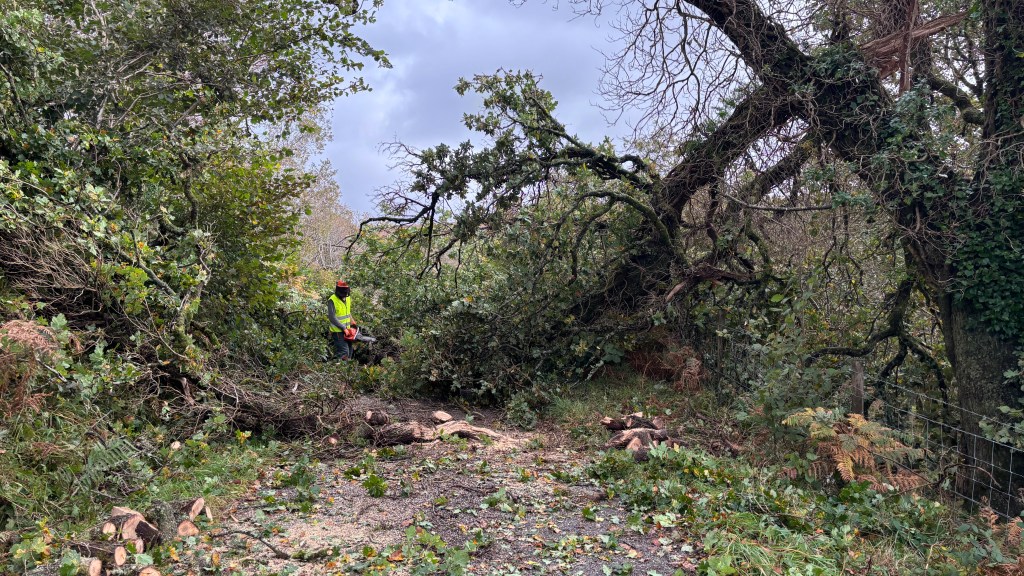
It was pretty wild here at Rhemore. A lot of large trees came down in the storm and we spent the best part of two days clearing the roads, paths and fences. We’ve been staying in our workshop while our house is being renovated so, as you can probably imagine, we didn’t get much sleep during the storm and were pretty cold, as there’s not much insulation. Other than this, we were basically fine. There was no damage to any buildings, and the new deer fence only has a few minor dents, (which is a relief as although Scottish Forestry paid for the fence there are no grants for mending or replacing it).
Some very big oak trees that were uprooted on the croft felt as familiar as old friends and I felt quite sad about this, until I spoke with Alasdair. He reminded me that storms and storm damage are a natural part of the life-cycle of a woodland. Fallen trees often stay alive and take on a new shape. Deadwood creates new habitats for all kinds of life and fallen trees create openings in the canopy that allow for new growth. He is more interested in seeing what will happen next in the woods as a result of the storm.
The increasing frequency of big storms like this might be more of an issue for humans than woodlands.
At least once a year, Alasdair looks around the croft to assess which trees might fall across the road or on fences and buildings and either takes down limbs or fells whole trees, but it’s impossible to know if he has got it right. Would those particular trees have fallen during this storm? Who knows! Each storm or flood is different: the angle of the wind, the number of leaves on each tree, the previous rainfall, the damage done in the last storm. Many of the ash trees on our croft half dead and earmarked for removal because of ash dieback, are still standing after storm Amy, whilst the big mother oaks we thought would last forever are now lying on the ground.
It made me think about our small community, and that you can’t always predict who will be vulnerable or need help. Peoples’ circumstances shift and change, just like ours did when we found ourselves sleeping in a cabin in 100 mph winds. The unexpected can always happen and I’m pretty sure believing you are prepared for anything can get you into as much if not more trouble than knowing you are not.
We have a tendency to see trees as individuals and forget about how they function as a woodland and it’s easy to do the same with people. It’s tempting to fortify ourselves and our homes in the hope we won’t ever need assistance, but when a big tree falls it usually takes others with it. It can be frustrating when it feels like others are ill-prepared or make bad decisions, but, like the trees, each of us has our strengths and our weaknesses.
The most heartening thing in the storm for us was when people, without judgement, welcomed us into the warm, gave us hot food and most importantly a sense that we weren’t alone in finding ourselves in difficulty, as it can happen to anyone.
For a woodland is stronger than an individual tree. Below and above ground trees are deeply intertwined and dependent upon each other, (and all the other species around them), in ways we still don’t understand fully. A tree’s roots are interwoven with a web of fungi in such a way that allows them to share resources and even warn each other about pests and drought. The key to the health of a woodland is the health of this fungi and the tree’s ability to communicate. In small communities, communication and cooperation is also key to resilience.
A fallen mother tree. The leaves acted as a sail.
Alasdair clearing a tree laden with Ivy.


Leave a Reply